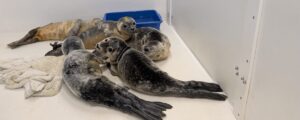
It has been a busy summer with our hotline receiving hundreds of calls, many seal pups in care, events across the state and more! We hope you enjoy this update on what’s happening now. Thank you for your support!
Notice to Maine Boaters
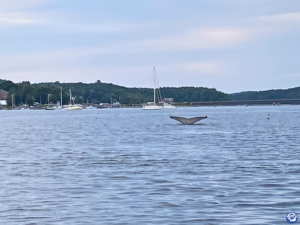
 ATTENTION MAINE BOATERS: Recently, humpback whales have been seen feeding close to shore in Maine waters, and our hotline has been fielding calls about these sightings. The opportunity to see whales is an exciting experience when watching in a way that is safe for you, your passengers, and the whales.
 Feeding whales move rapidly, frequently change direction underwater, and surface unpredictably. If following too closely, this can result in dangerous encounters- for the whales, people, and vessels. To safely watch these amazing animals:
See a spout, watch out!  Enter an area slowly and designate someone as a lookout.
Head On Is Wrong! Whales are protected under federal law, so interrupting their natural behaviors is illegal. Parallel the whale’s course and direction while staying at least 100 feet away (300 feet is better!) to avoid cutting off its path or getting too close- they can surface anywhere very quickly.
Avoid trouble, steer clear of bubbles! If you see any large bubbles or disturbances in the water or large bird aggregations, proceed with caution. A feeding whale is likely to surface in that space!
Lots of boats, then talk to folks! If there are other boats in the area, you can use your marine radio to hail them to gather more information about the whale(s).
Don’t chase, give the whales space! If a whale moves away from your boat, don’t chase it. Respect the whales’ behavior and keep your distance. Cautious boaters may get to see exciting natural behaviors.
Call the Maine Stranding Hotline: 1-800-532-9551 if you see an injured, dead, or entangled whale, dolphin, seal, or sea turtle in Maine. Please note: sightings may always be reported to the US Coast Guard via VHF Ch. 16. Here is where to find your local stranding network.
If you are fortunate enough to encounter whales in the wild outside of Maine, keep these safe boating guidelines handy as they apply to your, and the whales’ safety no matter where you are!
Pupdate
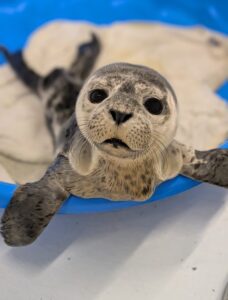
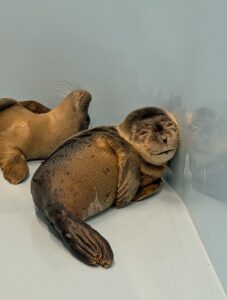
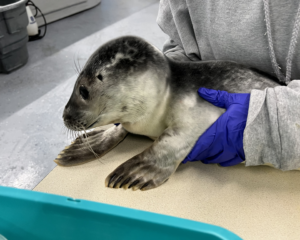
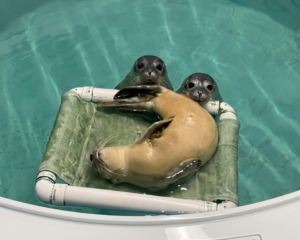
As we shared last month we’ve got lots of seal pups in care in our rehabilitation facility from all over New England- 15 to be exact! This is the most pups we’ve ever had for this extended period of time. In the past, we have temporarily cared for this volume of patients, transporting stabilized pups to other hospitals to make room for more. Without that option, we updated our facility, protocols, staffing, and supplies to ensure they can all receive specialized necessary care here for the duration of their recovery. All of them continue to gain strength and weight and learn skills necessary for survival in the wild. We’ve also been providing medical care for those fighting infections as well as for injuries some received prior to being admitted to our facility. A large number of pups here are also receiving care after experiencing human interaction which resulted in maternal abandonment.
We remain the only option for dependent pups in need of care in New England (where the vast majority of harbor seal pupping occurs) and these pups still have a way to go before they are ready for release. As these numbers demonstrate, there’s a tremendous need and we’re grateful for your support, which has helped us to say yes to these pups. Along with all these mouths to feed we spend a lot of time and resources cleaning, an important part of high quality care. We’re running low on one of our primary disinfecting solutions, Rescue Disinfectant, which is not available on our wishlists. We’re getting ready to place a bulk order to get the best price and keep us stocked through the year. If you’d like to contribute to this purchase you can donate here.
 |
 |
 |
 |
Policy Update
Representative Baumgartner of Washington State has introduced a bill that would amend the Marine Mammal Protection Act to allow for culling of pinnipeds (seals) in parts of the Northwest United States. The goal to promote recovery of salmon populations is an important one. Unfortunately, we do not believe that culling seals will achieve this goal and this issue is much more complex than can be solved by attempting to remove one species from the food chain. There are numerous historical examples of efforts like this resulting in complicated, harmful, ecosystem-wide impacts from culling one species to protect another. If you’d like to read the text and contact your representative you can do so here and this article features additional context and quotes from our colleagues at SR3.