There’s a bunch going on across all four pillars of our mission- response, rehabilitation, education and research. Here’s an update on what your support helps to make possible- thank you.
Pups are Home!
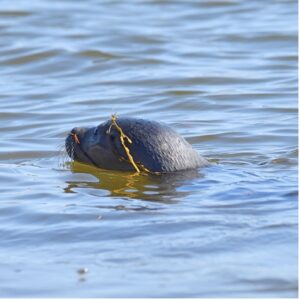
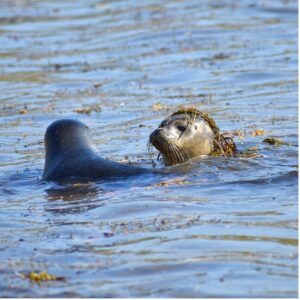
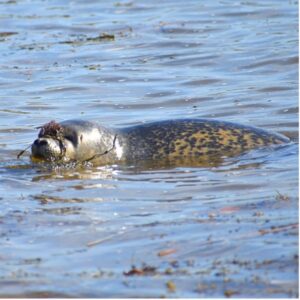
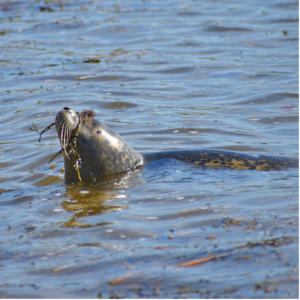
We hope you enjoyed our recent Friday Night Video and maybe you even got to join us for the public release in early September where we sent five harbor seal pups back to the wild. In total, 4 releases were held (not all public due to the needs of each unique patient). We’re thrilled that on October 1 we were able to hold a quiet release to send our final two pups from this busy summer season back to the wild. We hope you enjoy these photos of them enjoying life in the wild, (especially seaweed!) again.
 |
 |
 |
 |
This summer set records for our team due to the number of harbor seal pup patients we provided care for, as well as the number of pups we took in from outside our response region. It was a long, yet rewarding summer of reworking all of our patient workflows, staffing, volunteer help, supply orders, and more.
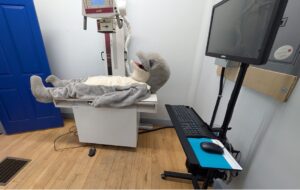 As resources for live stranded marine mammals in the Northeast reach scary lows, MMoME’s sense of responsibility to fill as many gaps as possible increases. Thanks to the steady support of our community, we have been able to rise to the challenge so far. This year thanks to a special donor and a funded grant proposal, we purchased an x-ray machine, elevating the diagnostic capabilities we can offer on site.
Uptick in Cetacean Strandings
Over the last several years, MMoME has been documenting steadily increasing numbers of cetacean (whale, dolphin, or porpoise) strandings. Last year, harbor porpoise and several dolphin species made up the majority of cetacean strandings documented. While many sample test results are still pending due to funding, one finding included a parasite of the inner ear. This is consistent with small cetacean necropsy (animal autopsy) results from cases throughout New England.
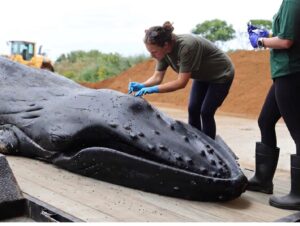
This year cetacean strandings continued to increase, becoming the highest number documented in a year (and it’s not over yet), and over the shortest period of time. Stranded species we’ve responded to include humpback and minke whales and evaluation of these cases is ongoing.
 |
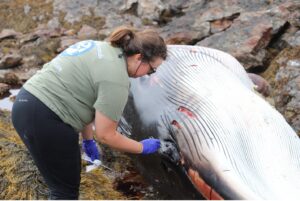 |
Above: Members of MMoME’s team collect samples from deceased whales.
Monitoring an Emerging Threat to Marine Mammal Health
Last month, a massive offshore algal bloom was identified throughout New England, bringing concern for potential impacts on marine wildlife, as well as human health.
Many algae species are non-toxic and form the critical base of both marine and freshwater food webs, providing essential food for many species. Other algae species produce toxins. Harmful Algal Blooms (HABs) become dangerous in high densities, especially those made up of the toxin-producing algae. When consumed in high quantities, severe illness or death can result. Because these toxins are present at the lowest levels of the food web and bioaccumulate in higher trophic levels, HABs can have widespread and severe impacts.
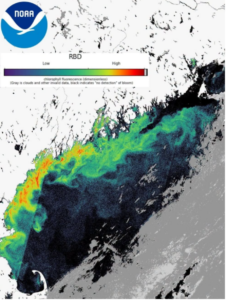
Satellite image of the Gulf of Maine large-scale algal bloom taken by NOAA National Centers for Coastal Ocean Science
Marine mammals are exposed to these toxins by feeding on prey such as fish that consume algae. Concern for HAB exposure to large whales such as minkes, humpbacks, and fin whales is heightened by the fact that they consume large quantities of fish when filter feeding.
Over the last several years, the West Coast of the United States has been documenting increasingly frequent and severe impacts of HABs -such as domoic acid-on marine mammals; primarily California sea lions stranding with neurologic conditions including seizures, and death. Tests on whales from the West Coast found potentially toxic levels of domoic acid as well, but impacts on whales are less understood.
While HABs are not uncommon on the East Coast of the U.S., their impact on marine mammals appears to be less direct, however little is currently known. MMoME has been working with NOAA, our stranding network colleagues, and researchers to collect marine mammal samples for HAB analysis. Fecal and GI contents were collected from large whales that stranded during the recent Northeast algal bloom and submitted to a study screening for biotoxins. This study aims to increase understanding of baseline toxin concentrations in baleen whales, identify emerging areas of concern for toxin exposure, and monitor for evolving impacts. Currently, no known impacts of the massive Northeast algal bloom on marine mammals were noted by our team, but samples collected and continued monitoring will shed more light on the health of these animals.
The Projected El Niño Winter and Marine Mammals
The National Weather Service’s Climate Prediction Center (CPC) is currently projecting a greater than 90% chance of a very strong El Niño event during the Northern Hemisphere’s 2026-2027 fall and winter. An El Niño winter occurs when the Pacific jet stream shifts, resulting in warmer sea surface and atmospheric temperatures. As a result, shifted storm tracks create and push more coastal storms and nor’easters up the Atlantic seaboard, and warmer sea and air temperatures tend to produce more rain versus snow. El Niño winters also increase the occurrence of coastal flooding.
What could this mean for Maine’s marine mammals this winter?
Winter strandings are typically made up of ice-seal species, such as harp and hooded seals, as some of their populations migrate from the Arctic to the Gulf of Maine. These species are highly adapted to cold weather conditions and rely on snow and ice for many aspects of survival, including hydration. See this earlier Friday Night Video about a happy harp seal reported to our hotline, and this video about a lesser-known impact of mild winters on ice-seals. During warmer winters with minimal snow accumulation, ice-seals are more at risk of dehydration, among other issues. Currently, MMoME is working with colleagues in the scientific community utilizing our extensive historic dataset to evaluate the impacts of environmental conditions on ice-seal health.
Gray seal hotline reports also tend to peak during the winter months as pupping takes place in December and January, and maternally-dependent and recently weaned pups are found along New England’s coast.
The projected severity of an El Niño winter could result in higher numbers of severely ill ice-seals and displaced gray seals due to coastal flooding. While these are all projections, as stranding responders we must be prepared for any number of cases and situations that may arise-espeically larger scale events that will require more resources (time, funds, rehab space, staffing, etc.) As-is our typical outlook, we hope for the best and prepare for the worst! Should these predictions result in sick, injured, and displaced marine mammals, we will be as prepared as possible to help.
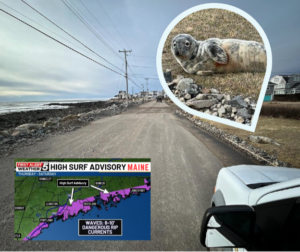 Above: In 2024, a recently weaned gray seal pup was reported to our hotline when a strong coastal storm with heavy surf landed her across the road from the beach and in someone’s front lawn. |
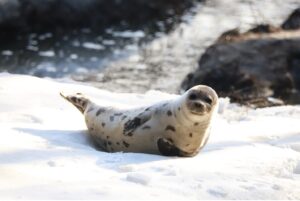 Above: A healthy, yearling harp seal reported to our hotline enjoying the frigid temps and snow it was built for! |
Thank you for your support!